

Key Highlights
- Automation = Execution: Best for the "deterministic drudgery" of rule-based, predictable tasks.
- AI Agents = Reasoning: Essential for interpreting unstructured data and navigating "messy" workflows.
- The Pivot Point: If a process requires analyzing multiple shifting data sources, it’s an Agent’s job.
- The Bottom Line: Automation optimizes for speed; AI Agents optimize for decision quality.
Across industries such as FMCG and retail operations, organizations are under increasing pressure to move faster, reduce operational costs, and respond to changing consumer demand. We’ve spent a decade trying to force-fit rigid automation into complex problems, but it’s time to admit that "If-Then" logic is no longer enough for a 2026 market.
Recently, the rise of AI agents has introduced a new layer of capability. Many companies are now experimenting with intelligent systems that can interpret information, make decisions, and coordinate actions across multiple tools. This shift has created both opportunity and confusion. The reality is that the future isn't "Automation vs. Agents"—it's a Hybrid Operating Model.
Case in Point: Walmart vs. Amazon
Retail giants demonstrate this balance perfectly. Walmart uses deterministic automation for high-speed warehouse sorting, but they recently deployed "Wally"—a reasoning-based AI agent—to diagnose the "why" behind supply chain anomalies that traditional rules couldn't catch. Similarly, Amazon has moved beyond simple logistics automation into Agentic Orchestration, using agents to simulate demand shocks and transition from "faster shipping" to "predictive resiliency."
Traditional Automation vs AI Agents: Understanding the Difference
Before deciding when to use AI agents, leaders must understand how the two approaches work. Many organizations treat them as interchangeable, but they solve very different problems.
Traditional automation focuses on executing predefined instructions. AI agents focus on interpreting situations and deciding what actions to take. To simplify this for your team, use the matrix below:
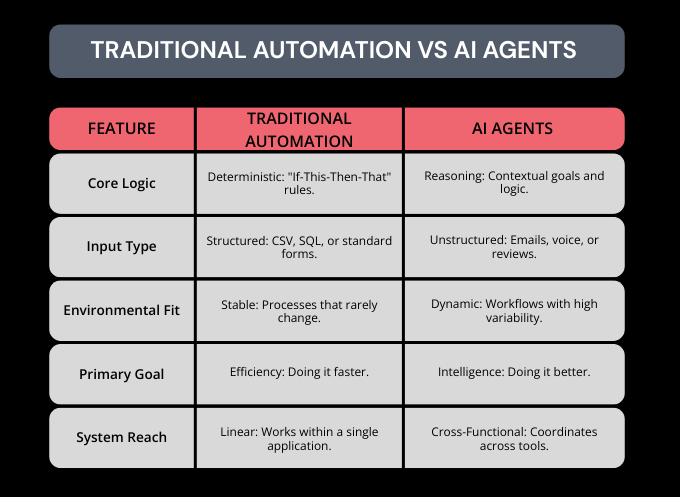
Traditional Automation
Traditional automation has been the backbone of enterprise operations for decades. It relies on clearly defined rules and structured workflows. Every step in the process is mapped in advance, and the system executes those steps exactly as programmed. When a specific trigger occurs, the system performs the corresponding action. If the trigger changes, the workflow must be updated manually by modifying the automation logic.
This approach works well because many operational processes follow predictable patterns. Retail order processing, payment reconciliation, warehouse inventory updates, and invoice validation all involve structured inputs and repeatable actions.
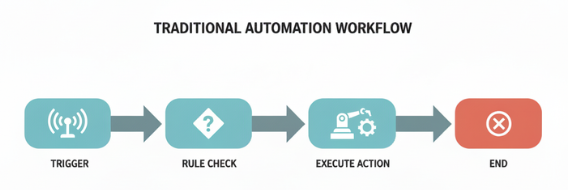
Because every step is predetermined, automation systems are extremely reliable and efficient. They reduce manual effort, increase processing speed, and ensure consistency in operations. However, this structure also introduces limitations. Automation assumes that the workflow will remain stable. When the process requires interpretation, contextual understanding, or dynamic decision-making, rule-based systems begin to struggle.
For example, if a retail company wants to reorder products whenever stock levels fall below a certain threshold, automation works perfectly. But if the reorder decision should depend on demand forecasts, supplier delays, seasonal demand, and regional sales patterns, the situation becomes more complex than a fixed rule can handle. This is where AI agents begin to offer advantages.
AI Agents
AI agents operate differently. Instead of simply executing predefined instructions, they analyze context and determine the next action based on available information. An AI agent can interpret data, evaluate options, and choose how to proceed. This allows it to handle situations where the process cannot be fully predicted in advance.
For example, an AI agent analyzing customer feedback could read thousands of product reviews, identify emerging concerns, categorize issues, and suggest corrective actions to product teams. This type of work involves interpretation rather than strict rule execution.
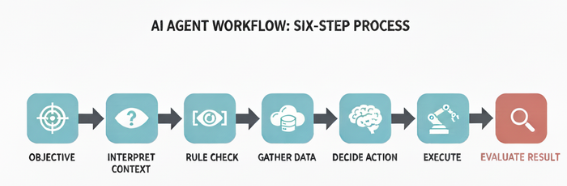
Since AI agents evaluate information before acting, they can handle tasks that involve uncertainty, variability, or changing conditions. For example, a retail AI agent analyzing product demand could review sales data, promotional campaigns, seasonal trends, and inventory levels before recommending adjustments to supply chain planning. Instead of executing a single rule, the system evaluates multiple variables to determine the best outcome. This ability to interpret and adapt makes AI agents particularly useful in environments where workflows cannot be fully predicted in advance.
The Key Differences
Understanding when to use traditional automation versus AI agents comes down to several fundamental differences. These differences determine whether a process benefits from rule-based execution or from intelligent decision-making.
1. Workflow Flexibility
Traditional automation
Automation systems follow a fixed workflow that must be designed in advance. If the process changes or a new scenario appears, the workflow must be manually updated. Over time, adding more rules and exceptions can make these systems difficult to maintain.
AI agents
AI agents are more flexible because they interpret context instead of relying only on predefined rules. They can adjust their actions based on the information they receive and the goal they are trying to achieve.
Example
A traditional automation may reorder stock when inventory falls below a specific number. If demand patterns change, the rule must be updated manually. An AI agent could analyze sales trends, seasonal demand, and supplier lead times before deciding how much stock to reorder.
2. Decision-Making Capability
Traditional automation
Automation executes instructions that are explicitly programmed. It does not evaluate alternative options or interpret the situation beyond the defined logic.
AI agents
AI agents analyze information and choose actions based on context. They can evaluate different possibilities and determine which action best fits the objective.
Example
In customer service operations, traditional automation may route requests based on keywords. An AI agent can understand the actual issue being described and route the request to the appropriate team even if the wording is unfamiliar.
3. Handling Complex Inputs
Traditional automation
Automation systems work best with structured inputs such as predefined forms, database fields, or standardized requests. When inputs vary widely, the system may fail or require additional rules.
AI agents
AI agents can interpret unstructured information such as text, documents, customer feedback, or emails. This allows them to process inputs that would be difficult to structure in advance.
Example
Retail companies analyzing product reviews often use AI systems to detect customer sentiment and emerging issues. Traditional automation cannot easily process these large volumes of varied text.
4. Ability to Coordinate Across Systems
Traditional automation
Automation typically operates within a specific system or workflow. Connecting multiple systems often requires complex integrations and predefined process logic.
AI agents
AI agents can interact with several tools and data sources while working toward a specific goal. This allows them to coordinate information across departments or operational systems.
Example
In supply chain operations, an AI agent might analyze demand forecasts, inventory levels, and supplier timelines before recommending adjustments. Traditional automation would require multiple independent workflows to handle the same task.
5. Adaptation to Change
Traditional automation
Automation performs best when processes remain stable. Frequent changes require developers to modify the workflow logic.
AI agents
AI agents adapt more easily because they focus on objectives rather than strict instructions. When new scenarios appear, the system evaluates the situation instead of relying on updated rules.
Example
Retail pricing strategies often change based on promotions and market demand. An AI agent can evaluate these conditions dynamically, while automation requires constant rule updates.
6. Implementation and Maintenance
Traditional automation
Automation is usually simpler to implement when processes are clearly defined. Maintenance is straightforward as long as the workflow remains stable.
AI agents
AI agents require more advanced infrastructure, data access, and governance mechanisms. They may involve higher implementation complexity but can reduce manual analysis and coordination work once deployed.
Example
Automating invoice processing may require only a rule-based system. Implementing an AI agent to analyze supplier relationships and negotiate purchasing strategies would require a more sophisticated setup.
7. Purpose of the System
Traditional automation
Automation focuses on task execution. The goal is to perform predefined actions efficiently and consistently.
AI agents
AI agents focus on goal achievement. The system determines what steps are required to reach the desired outcome.
Example
Automation might generate daily sales reports automatically. An AI agent could analyze those reports, identify performance trends, and recommend operational changes.
Why the Difference Matters
Deploying AI agents where traditional automation is sufficient often introduces unnecessary complexity and latency. AI systems require more computational resources and governance. If the workflow is already stable and predictable, automation remains the more reliable, cost-effective option.
Ask yourself: If this process broke tomorrow, would a manual update fix it, or would it require a three-hour meeting to figure out what went wrong? If it’s the latter, you need an Agent.
How to Decide: The 5-Step Evaluation Checklist
Use this checklist to determine if a specific process is a candidate for an AI Agent or should remain under traditional automation.
Analyze the Input:
[ ] Does the process rely on "messy" data like emails, long-form text, or nuanced customer feedback? (If yes, use an Agent)
Evaluate Decision Complexity:
[ ] Does the "next step" depend on multiple shifting variables like weather, competitor pricing, and inventory? (If yes, use an Agent)
Check Process Stability:
[ ] Does the logic of the task change more than once a month due to market factors? (If yes, use an Agent)
Define the Success Metric:
[ ] Is the primary goal to eliminate manual entry (Speed)? → Automation
[ ] Is the primary goal to reduce errors in judgment (Insight)? → AI Agent
Assess System Integration:
[ ] Does the task require "moving data" between three or more disconnected systems? (If yes, use an Agent as the connective reasoning layer)
Strategic Considerations for Leaders
In most FMCG and retail companies, operations fall into two categories. The first includes predictable workflows like invoice validation or warehouse scanning. These are the "muscular system" of your business—built for strength and repetition. Rule-based automation is the king here.
The second category includes decision-heavy processes like adjusting product promotions or responding to supply chain disruptions. This is the "nervous system"—built for sensing and reacting. AI agents deliver the most value here because they can analyze multiple signals and support faster human decision-making.
Conclusion
Traditional automation remains an essential component of modern operations. It is reliable, efficient, and well-suited for processes that follow predictable patterns. Replacing these systems with AI agents rarely produces meaningful improvements.
However, the most successful companies in 2026 are those that apply technology selectively. They use automation for execution and AI agents for interpretation. Leaders who win won't be the ones who automate the most tasks; they’ll be the ones who intelligently delegate the right decisions to the right systems.
Don't automate a mess—reason your way through it.