

Key Highlights
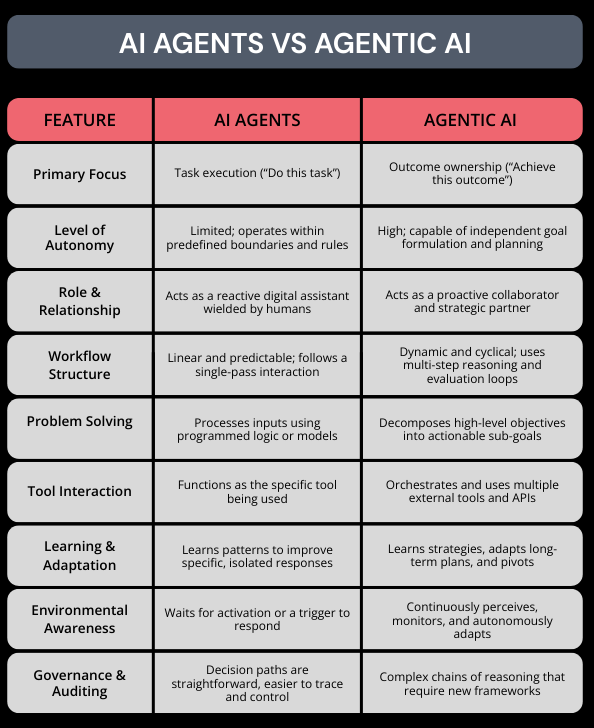
- AI agents execute defined tasks, while agentic AI manages broader goals through planning and coordination.
- The difference lies in autonomy: agents react within limits, agentic systems reason and adapt across steps.
- AI agents follow linear workflows; agentic AI operates through iterative planning and evaluation loops.
- Greater autonomy in agentic AI increases governance complexity and risk management requirements.
- The shift from automation to agentic systems reflects a move from task execution to structured goal management.
- Industry adoption remains uneven, with sectors like construction and agriculture showing strong future potential.
- The future will combine both models, using agents for execution and agentic systems for orchestration.
Artificial intelligence is evolving quickly, and new terms often appear before their meaning becomes clear. Two such terms are "AI agents" and "agentic AI." They are frequently used interchangeably, but they do not mean the same thing. Understanding the difference is important because each represents a different level of capability, autonomy, and system design.
This blog explains what AI agents are, what agentic AI means, how they differ, how their workflows operate, and where each fits in modern systems.
The confusion exists because both concepts involve autonomous behavior to some degree. Both can perform tasks, make decisions, and interact with systems. However, the level of independence and goal management differs significantly.
According to Google Cloud's explanation of agentic AI (Google Cloud, 2024), agentic systems are designed to pursue goals through planning and reasoning, rather than simply reacting to instructions. In contrast, AI agents are typically bounded systems that execute defined tasks within predefined rules. This distinction becomes clearer once both are defined properly.
What Is an AI Agent
An AI agent is a system designed to perceive input, process that input according to learned models or programmed rules, and produce a specific action. It operates within defined boundaries and focuses on completing a particular task.
At its core, an AI agent follows a structured interaction model. It receives data from an environment, interprets that data, and takes an action that is consistent with its defined objective. Once the action is completed, the interaction ends unless another input is provided.
For example, a customer support chatbot that answers predefined categories of questions is an AI agent. It interprets the query, retrieves relevant information, and responds. It does not independently redefine the user's objective. It does not expand the scope of its role. It operates within a clearly assigned function.
This bounded design gives AI agents three important characteristics:
- Predictability — Their actions remain within known limits.
- Efficiency — They perform repetitive tasks quickly and consistently.
- Governability — Their decision paths are easier to trace and control.
However, this same structure limits flexibility. AI agents are task-oriented. They do not independently plan multi-step strategies or coordinate across systems unless explicitly programmed to do so.
What Is Agentic AI
Agentic AI represents a broader level of system capability. Instead of focusing only on task execution, it focuses on goal achievement.
An agentic AI system does not simply respond to a single instruction. It interprets an objective, determines what steps are required to achieve that objective, sequences those steps, executes them, evaluates intermediate outcomes, and adjusts its strategy if necessary.
The defining feature here is planning combined with adaptability.
Where an AI agent executes a predefined action, an agentic AI system determines which actions are required. It can coordinate multiple tools, models, or agents to complete a broader objective.
For example, if given the goal "prepare a project performance analysis," an AI agent might generate a summary if provided with data. An agentic system, however, could:
- Identify which datasets are required
- Retrieve information from different systems
- Perform analysis
- Detect anomalies
- Draft findings
- Refine conclusions based on validation checks
The difference lies not just in complexity but in structure. Agentic AI introduces a loop of planning, acting, evaluating, and refining. This makes it proactive rather than reactive.
How AI Agents and Agentic AI Differ: Workflow Comparison
AI Agent Workflow
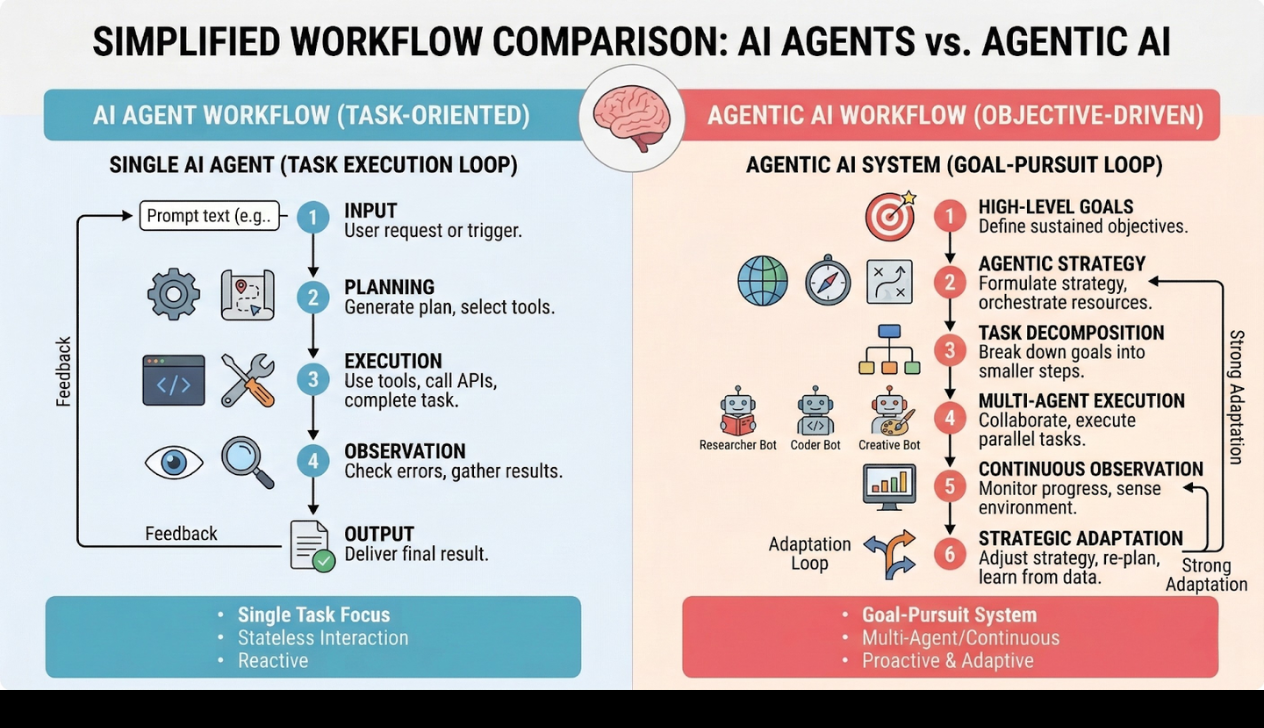
The workflow of an AI agent is typically linear. It can be described as:
Input → Processing → Action → Output
The system waits for a trigger. Once activated, it processes the input within a defined logic structure and produces a result. It does not revisit the objective unless prompted again.
This structure works well for:
- Customer service responses
- Content classification
- Transaction processing
- Simple automation tasks
Its reliability comes from its limited scope. However, if a problem requires iterative reasoning or coordination across multiple steps, the AI agent's architecture becomes restrictive.
Agentic AI Workflow
An agentic AI workflow is more dynamic and cyclical. It begins with an objective rather than a simple prompt. The system interprets that objective and breaks it down into smaller tasks. It selects appropriate tools or agents, executes steps in sequence, and continuously evaluates whether the results align with the intended goal.
If a step fails or produces incomplete results, the system adjusts its plan and tries an alternative approach.
The workflow resembles:
Goal → Decomposition → Planning → Execution → Evaluation → Revision → Completion
The key difference is the evaluation and revision stage. Agentic AI is not bound to a single pass. It can iterate. This introduces flexibility but also complexity. The system's decisions unfold across multiple steps, which makes tracing reasoning more challenging.
From Automation to Agentic Systems: A Meaningful Shift
To understand why agentic AI is considered a significant development, it helps to step back and look at how intelligent systems have evolved.
The earliest forms of automation were entirely rule-based. These systems operated on strict conditional logic. If a specific input was detected, a predefined action followed. There was no interpretation, no learning, and no flexibility. These systems were predictable but rigid. They worked well for repetitive processes, such as payroll calculation or inventory updates, but failed when faced with variation or ambiguity.
The introduction of AI agents marked an important improvement. Instead of relying only on fixed rules, AI agents could interpret patterns, process natural language, and make probabilistic decisions. They could handle variations in input and respond with greater flexibility than traditional automation. However, their structure remained task-bound. They could answer a question, classify a document, or route a request, but they did not decide what broader objective to pursue.
The transition to agentic AI represents a deeper architectural change. It shifts the focus from executing predefined tasks to managing objectives. This shift is not just about smarter responses. It is about systems that can reason about how to achieve a goal rather than simply reacting to a prompt.
This change became possible because several technologies matured at the same time. Large language models improved the ability of systems to interpret context and reason across multiple steps. Tool integration frameworks allowed AI systems to access external software and data sources. Memory mechanisms made it possible to retain state across interactions instead of treating each input independently. Evaluation loops enabled systems to assess whether intermediate outputs aligned with intended outcomes.
When these components are combined, the system can plan. Planning introduces structure across time. Instead of completing one action and stopping, the system evaluates progress and decides what to do next. That is what differentiates agentic AI from earlier forms of intelligent automation.
This shift also changes how systems are designed. Traditional automation and AI agents are built around predefined workflows. Agentic systems are built around dynamic workflows. They create the path while pursuing the objective. That difference is fundamental.
Risks and Limitations
Greater autonomy increases capability, but it also introduces new forms of complexity. AI agents are limited in scope, but their limitations are easy to understand. Because they operate within clearly defined boundaries, their behavior is relatively predictable. If an input falls outside their scope, they either fail or produce an incomplete result. The risk profile is contained because the system does not independently extend its role.
Agentic AI changes this equation. When a system is allowed to interpret objectives and plan its own steps, the number of possible actions expands significantly. That expansion introduces uncertainty.
One major risk lies in goal interpretation. If the system misunderstands the intent behind an objective, every subsequent decision may be built on a flawed foundation. Because agentic systems operate across multiple steps, early misinterpretations can cascade. What begins as a small misunderstanding can influence planning, execution, and evaluation.
Another concern is traceability. In a simple AI agent, the decision path is often straightforward. Input is processed, and output is generated. In agentic AI, decisions unfold across a chain of reasoning steps. Each step may depend on previous outputs, intermediate evaluations, and tool selections. This makes auditing more complex. Understanding why a system took a specific action requires examining not just the final output, but the entire sequence of reasoning.
There is also the issue of control boundaries. When a system can coordinate multiple tools or agents, it must operate within carefully defined constraints. Without clear limits, the system could execute actions that exceed its intended authority. In high-stakes environments such as finance, healthcare, or infrastructure management, this risk becomes especially important.
Human oversight remains essential. Autonomy does not eliminate accountability. Organizations must define where the system's authority begins and ends. Clear intervention points must exist so that humans can review decisions, override actions, or halt execution when necessary.
Another limitation is reliability across complex environments. Agentic systems may perform well in controlled scenarios but struggle when data sources are inconsistent or when objectives are ambiguous. Multi-step reasoning is powerful, but it relies heavily on accurate intermediate outputs. If one component fails, the entire chain can weaken.
In short, autonomy amplifies both strengths and weaknesses. The more freedom a system has, the more carefully it must be governed.
High-Opportunity Industries with Untapped Potential
AI adoption is not evenly distributed across industries. While sectors such as technology, financial services, and healthcare have moved quickly, several industries remain in earlier stages of implementation. These gaps represent meaningful opportunities for AI agents and agentic AI systems.
1. Construction and Infrastructure
The construction industry has historically been slower than other sectors in adopting digital technologies. Projects often involve multiple contractors, fragmented data systems, and complex regulatory requirements. Due to this, many processes in construction still depend heavily on manual coordination, spreadsheets, and disconnected tools.
According to the Deloitte Engineering and Construction Industry Outlook 2025, many firms are now exploring digital transformation to improve productivity and address long-standing issues such as project delays, cost overruns, and workforce shortages. However, the report also notes that the industry still faces challenges in scaling advanced technologies because data is often scattered across different systems and project participants. This environment creates a clear opportunity for intelligent systems.
AI agents can help automate structured operational tasks. For example, they can assist with document classification, contract management, safety reporting, and project documentation. These tasks consume a large portion of administrative time on construction projects and often involve repetitive workflows that are well suited for task-based automation.
Agentic AI could address more complex coordination problems that are common in large infrastructure projects. Construction projects require continuous adjustments as schedules change, supply chain issues arise, or site conditions evolve. An agentic system could analyze project timelines, monitor material availability, review risk indicators, and suggest adjustments to keep projects on track.
The Deloitte report highlights that improving productivity and managing project complexity are among the industry's most pressing priorities. Technologies that can connect fragmented data, identify risks earlier, and improve coordination across teams could significantly improve project outcomes.
As construction firms continue investing in digital tools, systems that combine task automation with broader planning capabilities may become increasingly valuable.
2. Agriculture and Food Production
Agriculture remains one of the most important industries globally, yet it is also one of the sectors where advanced digital technologies are adopted unevenly. Many farming operations still rely on manual monitoring, traditional knowledge, and fragmented data systems. While precision agriculture technologies have started to emerge, large-scale integration of intelligent systems is still developing.
Part of the challenge lies in infrastructure and skills. According to the World Economic Forum New Economy Skills 2025 report, sectors connected to agriculture and rural economies often face gaps in digital capabilities and access to advanced technologies. Many agricultural operations, especially smaller farms, do not yet have the technical workforce or digital infrastructure needed to implement sophisticated AI-driven systems. These limitations slow adoption even when the technology itself is available.
AI agents could help address some of the industry's immediate operational needs. For example, task-based systems can assist with monitoring crop health through satellite or sensor data, identifying pest risks, or analyzing soil conditions. These tools are particularly useful because they automate analysis that would otherwise require constant manual observation.
Agentic AI could support broader agricultural decision-making. Farming involves continuous adjustments based on weather patterns, soil conditions, supply chain availability, and market demand. Systems capable of coordinating multiple data sources could help farmers plan irrigation schedules, forecast crop yields, and manage logistics across planting, harvesting, and distribution.
The World Economic Forum report emphasizes that as digital capabilities expand across industries, agriculture will require new technology skills and digital tools to improve productivity and sustainability. Intelligent systems that combine automation with broader planning capabilities may play an important role in helping the sector modernize over time.
3. Public Sector and Government Administration
Compared with many private-sector industries, the public sector has adopted artificial intelligence more cautiously. Government organizations often manage sensitive citizen data, operate under strict regulatory frameworks, and must ensure transparency and accountability in every decision they make. These requirements make the adoption of new technologies slower and more carefully evaluated.
Research from McKinsey's State of AI report 2025 indicates that while AI adoption continues to grow across industries, implementation within government organizations often progresses at a slower pace than in technology, finance, or retail sectors. Many agencies are still in early experimentation stages, testing pilot programs before expanding AI across large administrative systems.
One reason for this slower adoption is the complexity of government workflows. Public sector processes frequently involve multiple departments, layers of approval, and extensive documentation. Introducing intelligent systems into these environments requires strong governance frameworks and clear accountability mechanisms. Despite these challenges, the opportunity for AI in government operations is substantial.
AI agents can support routine administrative functions that consume significant time within public institutions. For example, agents can assist with document classification, processing citizen requests, organizing regulatory filings, or responding to frequently asked questions through digital service platforms. These tasks are structured and repetitive, which makes them well suited for task-oriented systems.
Agentic AI could address more complex coordination challenges within government systems. Many public services require collaboration across departments, such as healthcare administration, infrastructure planning, or social service programs. An agentic system could help analyze case data, identify delays in processing, coordinate information across agencies, and suggest improvements in how services are delivered.
The McKinsey report highlights that organizations often struggle not with the availability of AI technology, but with scaling it effectively across complex operations. In the public sector, where processes are deeply interconnected, systems capable of coordinating tasks and analyzing outcomes could help governments improve efficiency while maintaining oversight.
4. Small and Medium Enterprises Across Traditional Services
Small and medium-sized enterprises play a major role in most economies, yet their adoption of advanced technologies such as artificial intelligence often progresses more slowly than in large organizations. Many SMEs operate with limited financial resources, smaller technology teams, and less access to specialized expertise. Because of these constraints, investing in new digital systems can feel risky or difficult to prioritize.
The OECD report on AI adoption by small and medium-sized enterprises explains that while many SMEs recognize the potential benefits of AI, they frequently face practical barriers when trying to implement it. These barriers include limited access to technical skills, uncertainty about return on investment, and difficulty integrating AI tools with existing business systems. In many cases, businesses rely on traditional processes because they do not yet have the infrastructure required to support more advanced automation.
Traditional service sectors illustrate this challenge clearly. Businesses such as local retailers, hospitality providers, logistics companies, and service operators often manage daily operations through manual coordination or basic digital tools. Tasks like scheduling staff, responding to customer inquiries, managing inventory, and tracking demand are often handled separately rather than through integrated systems.
AI agents could support many of these operational activities by automating routine tasks. For instance, task-based agents can assist with customer support, appointment scheduling, order processing, or analyzing basic sales data. These types of systems are relatively straightforward to implement and can reduce the administrative workload for small teams.
Agentic AI introduces the possibility of coordinating several of these functions together. Instead of handling individual tasks separately, a system could analyze customer demand, track inventory levels, adjust pricing strategies, and recommend operational changes based on patterns in the data. This kind of coordination could help smaller businesses make more informed decisions without requiring large internal analytics teams.
The OECD report also notes that improving access to digital skills and affordable technology solutions will be essential for increasing AI adoption among SMEs. As tools become easier to deploy and more integrated with existing platforms, intelligent systems may gradually become more accessible to smaller organizations across traditional service sectors.
5. Energy and Utilities in Emerging Markets
Energy systems around the world are becoming more complex as demand grows and energy sources diversify. Many countries are expanding renewable energy generation, modernizing electricity grids, and trying to improve energy reliability. At the same time, energy infrastructure in several emerging markets still relies on older systems that were not designed to handle modern levels of data, forecasting, and coordination.
The International Energy Agency's World Energy Outlook 2025 highlights that energy systems are undergoing rapid transformation as electricity demand increases and countries invest in new power technologies. However, the report also notes that many regions continue to face challenges related to infrastructure modernization, data integration, and grid management. These challenges are particularly visible in emerging markets where rapid growth in energy demand places additional pressure on existing systems.
In these environments, many operational processes remain highly manual. Utilities often depend on traditional monitoring systems and periodic reporting rather than continuous data-driven analysis. This makes it harder to anticipate disruptions, manage demand fluctuations, or coordinate supply across different energy sources.
AI agents could assist with several operational tasks within energy systems. For example, agents could analyze equipment data to identify maintenance needs, review operational logs, or monitor demand patterns. These types of applications focus on specific tasks and can help improve efficiency in day-to-day operations.
Agentic AI systems could address broader coordination challenges within energy networks. Modern energy systems must balance electricity generation from multiple sources, including renewables such as solar and wind. An agentic system could analyze weather forecasts, demand signals, and grid conditions to help operators make more informed decisions about energy distribution and resource planning.
The World Energy Outlook 2025 emphasizes that the global energy transition will require stronger digital capabilities to manage increasingly complex energy systems. As utilities modernize infrastructure and expand digital monitoring, intelligent systems that combine automation with coordinated decision support may become more important in managing energy networks efficiently.
Why These Gaps Represent Opportunity
Across these industries, three patterns are consistent:
First, workflows are complex and multi-step. This creates strong potential for agentic AI systems that can plan and coordinate tasks rather than simply execute them.
Second, data often exists but remains underutilized due to fragmentation. AI agents can begin with structured tasks, while agentic systems can gradually manage broader objectives.
Third, governance and risk management requirements are higher in these sectors. This slows adoption but also increases the long-term value of well-designed systems.
What These Systems Mean for the Future
The future of intelligent systems is unlikely to be defined by a single dominant model. Instead, it will likely involve layered architectures that combine the strengths of both AI agents and agentic AI.
AI agents will continue to play a central role in structured tasks. Their predictability, clarity of scope, and efficiency make them ideal for processes that require consistency. Many operational systems depend on this reliability, and that will not change.
Agentic AI systems are more likely to expand in areas where coordination across systems is required. As organizations integrate more digital tools and data sources, the ability to manage objectives across these systems becomes increasingly valuable. Instead of manually connecting processes, agentic systems may orchestrate them.
However, adoption will not be immediate or universal. Infrastructure readiness, governance frameworks, and trust in autonomous reasoning will determine how quickly agentic systems are deployed. In environments where risk tolerance is low, organizations may prefer incremental integration rather than full autonomy.
The trajectory suggests that agentic AI will often act as a supervisory layer rather than a complete replacement for existing agents. It may delegate tasks to specialized AI agents while retaining responsibility for planning and evaluation.
This approach allows systems to balance flexibility and control. Autonomy can be introduced gradually, beginning with limited objectives and expanding as reliability improves. The future will not simply reward the most autonomous system. It will reward systems that apply the right level of autonomy to the right problem.
Conclusion
AI agents and agentic AI represent different levels of intelligent system design. They are not competitors. They are stages in a progression. AI agents reflect a model of structured intelligence. They perform tasks efficiently and within known boundaries. Their strength lies in precision and reliability. Agentic AI reflects a model of coordinated intelligence. It manages objectives across steps and adapts when conditions change. Its strength lies in flexibility and strategic execution.
The distinction matters because it clarifies expectations. If a system is designed as an AI agent, it should not be expected to independently manage complex workflows. If a system is built as agentic AI, it must be supported by governance frameworks capable of handling higher autonomy.
Clear understanding prevents misuse. When the level of autonomy matches the complexity of the problem, intelligent systems can deliver meaningful results without introducing unnecessary risk.
The evolution from automation to agentic systems is not about replacing human judgment. It is about redefining how tasks and goals are distributed between humans and machines. Recognizing where task execution ends and goal orchestration begins is essential for designing responsible and effective intelligent systems.