
Key Highlights
- Traditional BI and real-time analytics are not competing technologies. They solve different problems for different kinds of decisions.
- Traditional BI works well for strategic planning, monthly reviews, and reports that need verified, reconciled data.
- Real-time analytics works well for operational decisions where the cost of delay is high, like fraud detection or supply chain alerts.
- Most enterprises do not need to choose one or the other. They need both, applied to the right kinds of decisions.
- The mistake to avoid is using one approach for the wrong kind of decision, which is where the investment usually goes to waste.
Introduction
Few questions in enterprise data architecture get asked more often than this one. Should we invest in real-time analytics, or stick with our traditional business intelligence stack? The answer most leaders are looking for is a simple yes or no on which technology to buy.
The honest answer is that the question is framed wrong. Real-time analytics and traditional BI are not two competing options that solve the same problem. They solve different problems, for different kinds of decisions, on different time scales. Picking the wrong one for a given decision is where most of the wasted spend happens.
This article walks through what each approach actually is, where each one works, and the kind of decision that needs which kind of cadence. The goal is to help you match the technology to the work it is meant to do, rather than picking based on what your vendor is currently selling.
What Traditional BI Actually Is
Traditional business intelligence is the family of tools and practices that turn historical business data into reports, dashboards, and analyses. Data flows from operational systems like the CRM, the ERP, and the finance system into a data warehouse on a scheduled basis. Once a day is common. Once an hour is faster. Once a week is normal for some processes. The data warehouse stores the reconciled, governed version of the business truth. Tools like Power BI, Tableau, Looker, and Qlik connect to that warehouse and let analysts and business users explore the data, build reports, and create dashboards.
The strengths of traditional BI are well understood at this point. It provides a single, governed source of truth that the entire organization can trust. It supports detailed historical analysis. It works well for the kind of decisions that have a longer time horizon: quarterly planning, monthly business reviews, annual budgeting, compliance reporting, financial close. The data has had time to settle. Reconciliations have happened. Errors have been corrected. The numbers in the dashboard are the numbers the CFO will sign off on.
The weaknesses are also well known. Traditional BI is slow by design. The data you see today reflects what happened yesterday or last week. The dashboards depend on the data team to build and maintain. Business users often wait days or weeks for a new report. And when the moment requires a decision in seconds, traditional BI simply is not the right tool for the job.
What Real-Time Analytics Actually Is
Real-time analytics is the family of tools and practices that processes data the moment it is generated and produces insights or actions within milliseconds to seconds. Instead of moving data into a warehouse on a schedule, real-time systems use streaming platforms like Apache Kafka, Apache Flink, or modern streaming databases to handle continuous flows of events. Insights are generated on the fly, dashboards update live, alerts trigger as soon as a threshold is crossed, and automated systems can act before a human is even aware that something happened.
The strengths of real-time analytics show up in any situation where the cost of delay is high. Fraud detection is the classic example. A credit card transaction needs to be approved or declined in under a second. There is no time to load yesterday's batch into a warehouse and run a SQL query against it. The same logic applies to dynamic pricing in e-commerce, supply chain disruption alerts, cybersecurity monitoring, customer service troubleshooting, and live system performance monitoring. In each case, the decision needs to happen now, or it loses its value.
The weaknesses are real and worth knowing. Real-time analytics is more expensive to build and operate than traditional BI. The infrastructure is more complex. The talent requirements are higher. The data is raw and event-driven rather than reconciled and governed, which means real-time numbers and traditional BI numbers will not always match exactly. And much of what looks like a real-time use case actually does not need real-time at all. A monthly sales report does not become more useful because it updates every second.
The Detailed Comparison
The cleanest way to see the difference is side by side. The table below covers eleven of the most important factors, including decision cadence, technical architecture, cost shape, and team requirements.
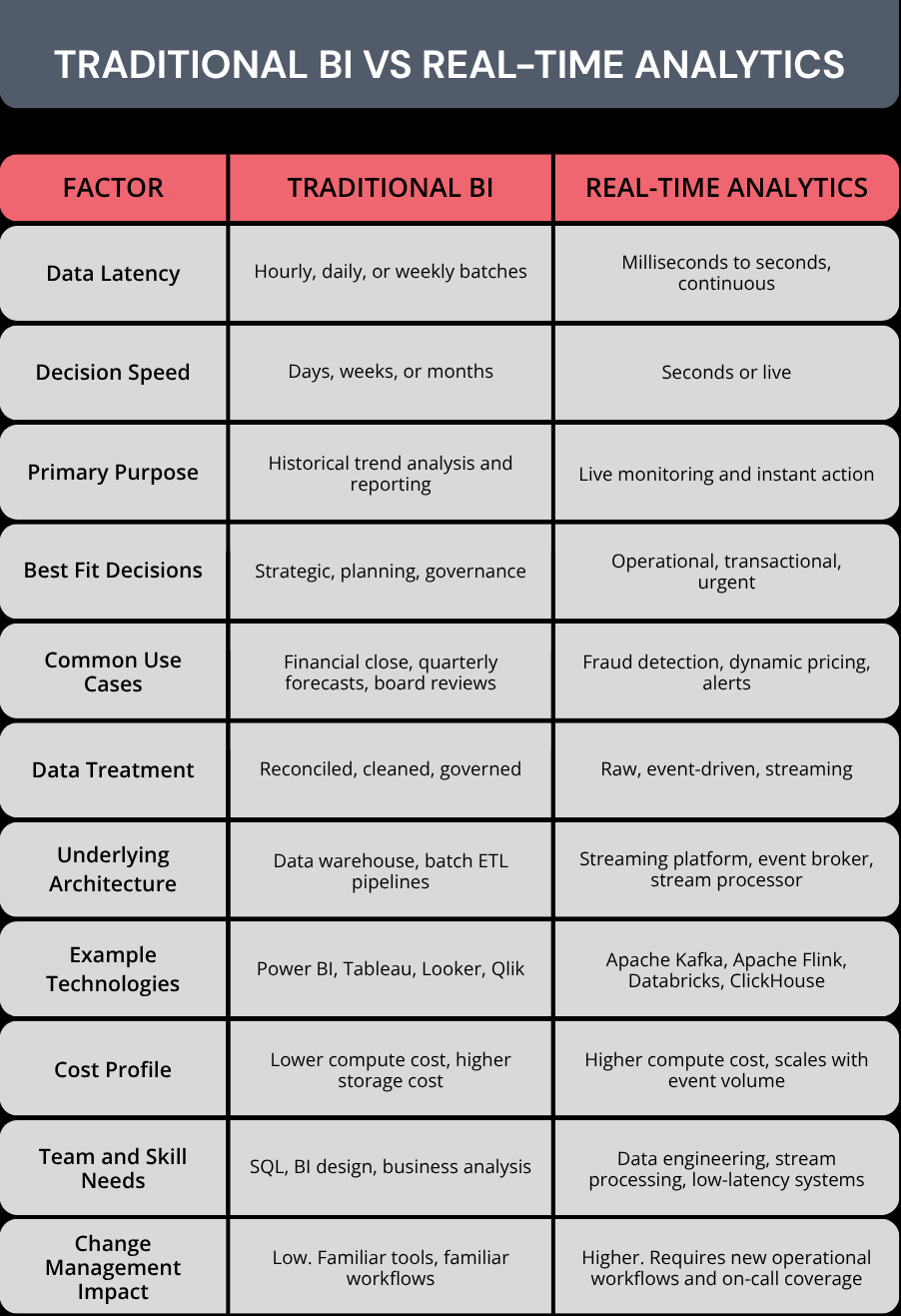
The table is not a scoreboard. Neither column is better than the other in isolation. Each column is a good fit for a specific kind of work, and a poor fit for the other kind.
Which Decisions Need Which Cadence
The cleanest way to choose between traditional BI and real-time analytics is to start with the decision the technology is meant to support, not the technology itself. Two simple questions usually resolve the choice.
Q1. How much does a one-day delay cost? If the answer is "nothing meaningful," traditional BI is almost always the right fit. Annual planning, monthly business reviews, quarterly forecasting, compliance reporting, board materials. None of these get better if the data updates every second. They get better if the data is correct, reconciled, and trusted. Traditional BI is designed for exactly this.
If the answer is "a lot," real-time analytics starts to earn its place. A delayed fraud check loses money on every transaction. A delayed pricing update on a competitive product loses market share by the hour. A delayed alert on a supply chain disruption can stop a production line. A delayed system outage notification multiplies the customer impact.
Q2. Is the decision automated or human-driven? Many real-time use cases involve automated decisions. A fraud model approves or declines a transaction. A pricing engine adjusts the price on a product. A trading algorithm executes a trade. In these cases, real-time is required, because no human can act fast enough.
Human-driven decisions are different. A regional manager reviewing weekly sales does not need second-by-second updates. An executive reviewing quarterly performance does not need a live feed. Traditional BI fits human-driven, slower-cadence decisions cleanly.
The combination of these two questions usually settles the matter. The decisions that cost money when delayed and run through automation belong in real-time. The decisions that involve human judgment on a slower clock belong in traditional BI. Trying to force a decision into the wrong cadence is the most common and most expensive mistake.
The Hybrid Most Enterprises Actually Build
The framing of "real-time vs traditional BI" can make it sound like a one-or-the-other choice. In practice, most large enterprises run both, side by side, for different parts of the business.
The pattern that works looks something like this. Traditional BI handles the parts of the business that depend on reconciled, governed, trustworthy data. Finance close. Compliance and audit. Quarterly and annual reporting. Strategic planning. Customer and market segmentation. These run on the warehouse, on a daily or weekly cadence, with the data team owning the pipeline and the business teams consuming dashboards.
Real-time analytics handles the parts of the business where the cost of delay is high. Fraud and risk detection. Dynamic pricing on competitive products. Supply chain monitoring. Operational dashboards for live systems. Customer service troubleshooting. These run on streaming infrastructure, often closer to the operational systems they monitor, with engineering and operations teams owning the alerts and automated responses.
The two stacks can connect. Reconciled data from the warehouse can feed real-time models. Real-time event data can flow into the warehouse for later historical analysis. But the two are running on different clocks for different purposes, and pretending one stack should do both jobs is what produces the disappointment most enterprises eventually feel about their analytics investment.
The Shift Toward AI-Augmented Analytics
A trend worth watching across both traditional BI and real-time analytics is the move toward AI-augmented and conversational interfaces. The classic bottleneck of traditional BI was that business users had to wait for the data team to build a new dashboard or write a new query. Modern AI-powered analytics platforms are starting to close that gap. Business users can ask questions in natural language and get answers without writing SQL or waiting for an analyst.
This shift is changing both sides of the comparison. Traditional BI tools are gaining real-time query capabilities and AI-driven insights. Real-time analytics platforms are gaining easier-to-use interfaces that let non-engineers work with streaming data. The lines between the two categories are blurring at the interface layer, even as the underlying architectural distinction remains real.
What is not changing is the core question this article started with. The decision the analytics is meant to support still determines what kind of analytics you actually need. The interface is improving on both sides. The architectural choice is still the architectural choice.
The Finzarc View
The right question is not whether to invest in real-time analytics or stick with traditional BI. The right question is which decisions in your business need which kind of cadence, and whether your current architecture supports both well.
This is the work we focus on at Finzarc. Helping enterprises map decisions to the right analytics cadence, build the architecture that supports both where both are needed, and avoid the common mistake of paying for real-time infrastructure when traditional BI would have been the right fit, or settling for traditional BI when the business is losing money to delays it could be prevented.
The technology is the easier part. Matching the technology to the work is where the value is captured or lost.